When a storm knocks out water and sewer service, Portsmouth Heights Porta Pros can get standard units on site within hours, not days. A single standard portable toilet covers roughly 10 people for a week under the ANSI/PSAI Z4.3 service baseline. We scale that up fast for shelters, staging areas and whole neighborhoods.
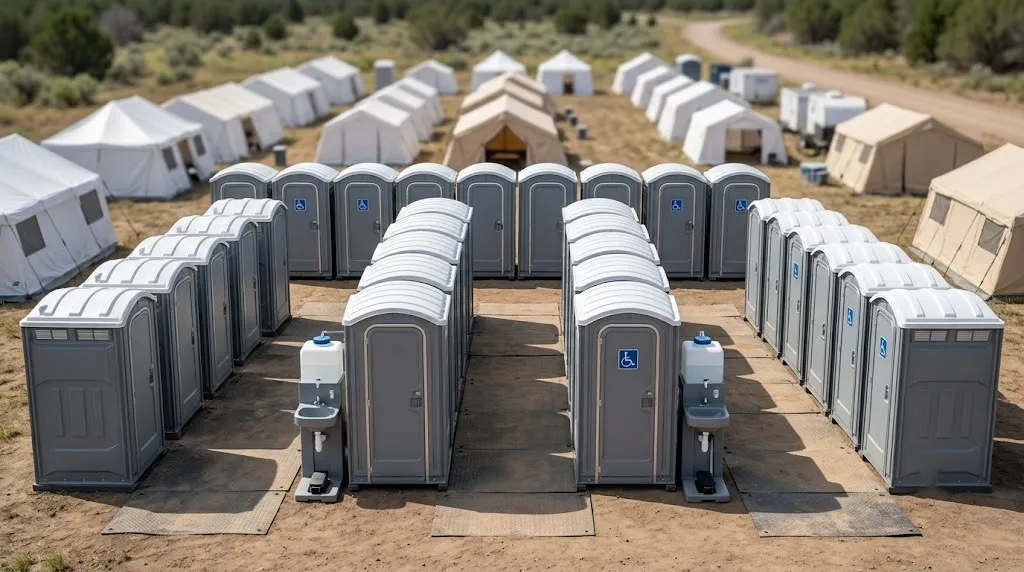
Sewer lines back up, wells flood, and lift stations lose power. That is when a neighborhood in Portsmouth Heights goes from working toilets to none in about an hour. We treat these calls as emergency porta potty rental dispatches, which means the truck moves before the paperwork is finished. A standard unit holds 60 to 70 gallons in its tank and stands about 92 inches tall, so it fits in tight driveways, parking lots and church lawns without needing a lot of setup room. For a shelter or command post pulling in dozens of displaced residents, we usually recommend clustering several portable restroom rental units together rather than spacing them out, because it cuts servicing time in half when our truck arrives.
If the site also needs to feed or triage people, handwashing matters just as much as toilets. 29 CFR 1910.141(d)(2) requires soap and a way to dry hands, not just sanitizer, so we pair every restroom cluster with a handwashing station rental unit stocked to that standard. Chesapeake sits about 20.5 miles south of Portsmouth Heights, and Carrollton is 15.8 miles northwest, so if a storm knocks out our nearest depot we still have routes in from both directions. We also run portable sink rental units for kitchens and feeding stations that pop up at relief sites, since those need a dedicated wash setup separate from the restrooms.
Delivery windows shrink to hours once roads clear, because disaster response gets priority routing ahead of standard bookings. A roll-off delivery truck needs about 60 feet of straight clearance behind it, which matters when debris or downed limbs are blocking half a driveway in Portsmouth Heights. We check that clearance before the truck leaves the yard, not after it gets stuck. For sites collecting storm debris alongside sanitation needs, we bring in a roll-off dumpster rental unit at the same time as the restrooms, so crews are not making two separate calls.
Standard toilet pricing during active response runs the same bands as everyday rental: a standard porta potty rental unit lands between $100 and $350 a day depending on volume and duration, with weekly and monthly rates dropping the per-day cost. Accessibility does not get dropped during an emergency either. ADA Standards section 213.2 requires at least one accessible unit in any cluster, and never fewer than 5 percent of the total, so a shelter running ten standard toilets needs at least one ADA accessible porta potty in that lineup.
| unit | duration | low | typical | high |
|---|---|---|---|---|
| standard | day | 100 | 150 | 350 |
| standard | week | 130 | 200 | 500 |
| ada | day | 200 | 230 | 400 |
| delivery_fee | day | 100 | 150 | 500 |
For longer-term recovery, when families are displaced for weeks, a monthly porta potty rental plan or a full restroom trailer rental setup makes more sense than daily toilets stacked up over and over. An 8 stall restroom trailer can serve a shelter housing dozens of people without the line management problems that come with standalone units.
Yes, if the site has workers on it, not just displaced residents. OSHA 1926.51(c)(1) sets the construction ratio at one toilet facility for 20 workers or fewer, climbing to one toilet and one urinal per 40 workers once the crew passes 20. A disaster relief operation with volunteers, contractors and utility crews clearing debris in Portsmouth Heights counts as a jobsite under that standard, so the ratio applies to the response team even before you count the people they are helping. Crews doing debris removal with chemical treatments, like herbicide spraying near flooded ground, trigger OSHA 1926.51(f)(1) washing requirements too.
We also bring temporary fence rental panels to keep foot traffic away from staging equipment and downed lines, and light tower rental units so night shifts at a relief site are not working in the dark. If the storm has taken out grid power on top of everything else, a temporary power pole hookup keeps the trailers and pumps running. For questions on how many units a given headcount actually needs, our how many porta potties do I need guide walks through the math behind the OSHA ratio.
Once roads are passable, we treat shelter requests as priority dispatches and aim for same-day delivery. Exact timing depends on road conditions and how many units the shelter needs. Call ahead through our request a quote page so we can start routing a truck immediately.
Yes. We pair restroom clusters with handwashing units that meet 29 CFR 1910.141(d)(2), which requires soap and towels or a hand-drying device, not sanitizer alone. This matters most at feeding stations and shelters.
We need roughly 60 feet of straight clearance behind our roll-off truck, and standard delivery vehicles need a similar approach. If debris is blocking the route, tell us when you call so we can plan around it.
Longer deployments usually make more sense with a monthly porta potty rental plan or a restroom trailer instead of daily units. We will help you figure out which fits the headcount and duration.
Yes. ADA Standards section 213.2 requires at least one accessible unit per cluster, never fewer than 5 percent of the total. We stock ADA accessible porta potty units for exactly this need.
Yes. Portsmouth Heights Porta Pros delivers disaster relief sanitation across Portsmouth Heights and the surrounding metro, with same-day and next-day drop-off available on most orders.
Pricing depends on the unit and how long you need it. See our cost breakdown and request a free quote for an exact figure.
Standard rentals include scheduled service — a pump-out, a clean, a restock and fresh deodorizer. Busy or hot-weather sites can be serviced more often.
Call now or request a free quote — clean units, on-time delivery, transparent pricing.